 Cookies
Wir benötigen Ihre Einwilligung zur Verwendung der einzelnen Daten, damit Sie unter anderem Informationen zu Ihren Interessen einsehen können. Klicken Sie auf "OK", um Ihre Zustimmung zu erteilen.
ASTM A262-13
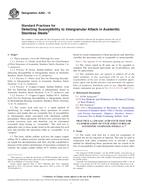
Standard Practices for Detecting Susceptibility to Intergranular Attack in Austenitic Stainless Steels
Automatische name übersetzung:
Standard-Practices für die Erkennung von Anfälligkeit für interkristalline Angriff in austenitischen Edelstählen
NORM herausgegeben am 1.5.2013
Informationen über die Norm:
Bezeichnung normen: ASTM A262-13
Anmerkung: UNGÜLTIG
Ausgabedatum normen: 1.5.2013
SKU: NS-1792
Zahl der Seiten: 17
Gewicht ca.: 51 g (0.11 Pfund)
Land: Amerikanische technische Norm
Kategorie: Technische Normen ASTM
Die Annotation des Normtextes ASTM A262-13 :
Keywords:
austenitic stainless steel, copper sulfate, corrosion testing, etch structures, ferric sulfate, intergranular corrosion, nitric acid, oxalic acid, ICS Number Code 77.140.20 (Steels of high quality)
Ergänzende Informationen
| 1. Scope | ||||||||||||||
|
1.1 These practices cover the following five tests: 1.1.1 Practice A—Oxalic Acid Etch Test for Classification of Etch Structures of Austenitic Stainless Steels (Sections 3 to 7, inclusive), 1.1.2 Practice B—Ferric Sulfate–Sulfuric Acid Test for Detecting Susceptibility to Intergranular Attack in Austenitic Stainless Steels (Sections 1.1.3 Practice C—Nitric Acid Test for Detecting Susceptibility to Intergranular Attack in Austenitic Stainless Steels (Sections 15 to 21, inclusive), 1.1.4 Practice E—Copper–Copper Sulfate–Sulfuric Acid Test for Detecting Susceptibility to Intergranular Attack in Austenitic Stainless Steels (Sections 1.1.5 Practice F—Copper–Copper Sulfate–50 % Sulfuric Acid Test for Detecting Susceptibility to Intergranular Attack in Molybdenum-Bearing Austenitic Stainless Steels (Sections 32 to 38, inclusive). 1.2 The oxalic acid etch test is a rapid method of identifying, by simple etching, those specimens of certain stainless steel grades that are essentially free of susceptibility to intergranular attack associated with chromium carbide precipitates. These specimens will have low corrosion rates in certain corrosion tests and therefore can be eliminated (screened) from testing as “acceptable.” The etch test is applicable only to those grades listed in the individual hot acid tests and classifies the specimens either as “acceptable” or as “suspect.” 1.3 The ferric sulfate–sulfuric acid test, the copper–copper sulfate–50 % sulfuric acid test, and the nitric acid test are based on weight loss determinations and, thus, provide a quantitative measure of the relative performance of specimens evaluated. In contrast, the copper–copper sulfate–16 % sulfuric acid test is based on visual examination of bend specimens and, therefore, classifies the specimens only as acceptable or nonacceptable. 1.4 The values stated in SI units
are to be regarded as standard. The inch-pound equivalents are in
parentheses and may be approximate.
1.5 This standard does not
purport to address all of the safety problems, if any, associated
with its use. It is the responsibility of the user of this standard
to establish appropriate safety and health practices and determine
the applicability of regulatory limitations prior to use.
Standard Test Methods and Definitions for
Mechanical Testing of Steel Products Standard Practice for Cleaning,
Descaling, Pickling, and Passivation of Stainless Steel Parts,
Equipment, and Systems Standard Specification for Reagent
Water Standard Guide for Preparation of
Metallographic Specimens ASME Boiler & Pressure Vessel
Code, Reagent Chemicals, Specifications and Procedures Determination of Resistance to
Intergranular Corrosion of Stainless Steels--Part 2: Ferritic,
Austenitic, and Ferritic-Austenitic (Duplex) Stainless
Steels--Corrosion Test in Media Containing Sulfuric Acid |
Empfehlungen:

Aktualisierung der technischen Normen
Wollen Sie sich sicher sein, dass Sie nur die gültigen technischen Normen verwenden?
Wir bieten Ihnen eine Lösung, die Ihnen eine Monatsübersicht über die Aktualität der von Ihnen angewandten Normen sicher stellt.
Brauchen Sie mehr Informationen? Sehen Sie sich diese Seite an.