 Cookies
Wir benötigen Ihre Einwilligung zur Verwendung der einzelnen Daten, damit Sie unter anderem Informationen zu Ihren Interessen einsehen können. Klicken Sie auf "OK", um Ihre Zustimmung zu erteilen.
ASTM D1883-99
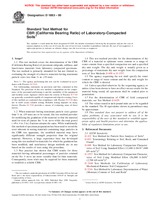
Standard Test Method for CBR (California Bearing Ratio) of Laboratory-Compacted Soils
Automatische name übersetzung:
Standardtestverfahren für CBR (California Bearing Ratio ) des Labor verdichteten Böden
NORM herausgegeben am 10.2.1999
Informationen über die Norm:
Bezeichnung normen: ASTM D1883-99
Anmerkung: UNGÜLTIG
Ausgabedatum normen: 10.2.1999
SKU: NS-18659
Zahl der Seiten: 8
Gewicht ca.: 24 g (0.05 Pfund)
Land: Amerikanische technische Norm
Kategorie: Technische Normen ASTM
Die Annotation des Normtextes ASTM D1883-99 :
Keywords:
Bearing ratio, California bearing ratio (CBR), Compression testing-soil, Earthwork, Foundation investigations, Loading tests-soil, Pavement surfaces, Penetration-soil, Recycled (paving) materials, Roadways, Soil-cohesionless, Soil-penetration, Soil-aggregate, Strength, Subbase, California bearing ratio of laboratory-compacted soils (pavement, subgrade/subbase/course materials), test, ICS Number Code 93.020 (Earth works. Excavations. Foundation construction. Underground works)
Ergänzende Informationen
| 1. Scope | ||||||||||||||||||||||||||||||
|
1.1 This test method covers the determination of the CBR (California Bearing Ratio) of pavement subgrade, subbase, and base/course materials from laboratory compacted specimens. The test method is primarily intended for but not limited to, evaluating the strength of cohesive materials having maximum particle sizes less than 3/4 in. (19 mm). Note 1-The agency performing this test can be evaluated in accordance with Practice D3740. Not withstanding statements on precision and bias contained in this Standard: The precision of this test method is dependent on the competence of the personnel performing it and the suitability of the equipment and facilities used. Agencies which meet the criteria of Practice D3740 are generally considered capable of competent and objective testing. Users of this method are cautioned that compliance with Practice D3740 does not in itself assure reliable testing. Reliable testing depends on many factors; Practice D3740 provides a means of evaluating some of those factors.1.2 When materials having maximum particle sizes greater than 3/4 in. (19 mm) are to be tested, this test method provides for modifying the gradation of the material so that the material used for tests all passes the 3/4-in. sieve while the total gravel (+No. 4 to 3 in.) fraction remains the same. While traditionally this method of specimen preparation has been used to avoid the error inherent in testing materials containing large particles in the CBR test apparatus, the modified material may have significantly different strength properties than the original material. However, a large experience base has developed using this test method for materials for which the gradation has been modified, and satisfactory design methods are in use based on the results of tests using this procedure. 1.3 Past practice has shown that CBR results for those materials having substantial percentages of particles retained on the No. 4 sieve are more variable than for finer materials. Consequently, more trials may be required for these materials to establish a reliable CBR. 1.4 This test method provides for the determination of the CBR of a material at optimum water content or a range of water content from a specified compaction test and a specified dry unit weight. The dry unit weight is usually given as a percentage of maximum dry unit weight from the compaction tests of Test Methods D698 or D1557. 1.5 The agency requesting the test shall specify the water content or range of water content and the dry unit weight for which the CBR is desired. 1.6 Unless specified otherwise by the requesting agency, or unless it has been shown to have no effect on test results for the material being tested, all specimens shall be soaked prior to penetration. 1.7 For the determination of CBR of field compacted materials, see Test Method D4429. 1.8 The values stated in inch-pound units are to be regarded as the standard. The SI equivalents shown in parentheses may be approximate. 1.9 This standard does not purport to address all of the safety problems, if any, associated with its use. It is the responsibility of the user of this standard to establish appropriate safety and health practices and determine the applicability of regulatory limitations prior to use. |
||||||||||||||||||||||||||||||
| 2. Referenced Documents | ||||||||||||||||||||||||||||||
|
Empfehlungen:

Aktualisierung der technischen Normen
Wollen Sie sich sicher sein, dass Sie nur die gültigen technischen Normen verwenden?
Wir bieten Ihnen eine Lösung, die Ihnen eine Monatsübersicht über die Aktualität der von Ihnen angewandten Normen sicher stellt.
Brauchen Sie mehr Informationen? Sehen Sie sich diese Seite an.