 Cookies
Wir benötigen Ihre Einwilligung zur Verwendung der einzelnen Daten, damit Sie unter anderem Informationen zu Ihren Interessen einsehen können. Klicken Sie auf "OK", um Ihre Zustimmung zu erteilen.
ASTM D5573-99
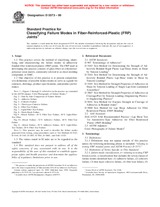
Standard Practice for Classifying Failure Modes in Fiber-Reinforced-Plastic (FRP) Joints
Automatische name übersetzung:
Standard Praxis für die Klassifizierung von Failure Modes in faserverstärkten - Kunststoff (GFK ) Gelenke
NORM herausgegeben am 10.4.1999
Informationen über die Norm:
Bezeichnung normen: ASTM D5573-99
Anmerkung: UNGÜLTIG
Ausgabedatum normen: 10.4.1999
SKU: NS-31717
Zahl der Seiten: 3
Gewicht ca.: 9 g (0.02 Pfund)
Land: Amerikanische technische Norm
Kategorie: Technische Normen ASTM
Die Annotation des Normtextes ASTM D5573-99 :
Keywords:
Adhesive bonding, Adhesive failure, Bonded assemblies, Classification (standards)-adhesives, Cohesive failure, Failure end point-adhesives, Fiber-reinforced-plastic (FRP), Fiber-tear (FT), Light-fiber-tear failure (LFT), Mixed failure, Stock-break failure (SB), Thin-layer cohesive failure (TLC), classifying failure modes-fiber-reinforced-plastic (FRP) joints,, practice, ICS Number Code 83.120 (Reinforced plastics)
Ergänzende Informationen
| 1. Scope | ||||||||||||||||||
|
1.1 This practice covers the method of classifying, identifying, and characterizing the failure modes in adhesively bonded fiber-reinforced-plastic (FRP) joints. The FRP used in developing this practice consists of glass fibers in a thermoset-polyester-resin matrix, commonly referred to as sheet-molding compound, or SMC. 1.2 One objective of this practice is to present comprehensive definitions of possible failure modes to serve as a guide for contracts, drawings, product specifications and product performance. Note 1-Figures 2 through 11 referred to in the practice are contained in the ASTM adjunct, Color Photographs of Failure Modes. Fig. 2-Side-by Side Comparison of Failure Modes Fig. 3-Adhesive Failure Fig. 4-Cohesive Failure Fig. 5-Thin-Layer Cohesive Failure Fig. 6-Fiber-Tear Failure Fig. 7-Light-Fiber-Tear Failure Fig. 8-Stock-Break Failure Fig. 9-Mixed Failure-40% Fiber-Tear Failure, 60% Light-Fiber- Tear Fiber Fig. 10-Mixed Failure-32% Adhesive Failure, 68% Fiber-Tear Failure Fig. 11-Mixed Failure-20%Adhesive Failure, 60% Light-Fiber-Tear Failure, 20% Fiber-Tear Failure Note 2-This practice may be used to describe the failure modes generated from testing, using procedures such as Test Methods D3163, D3164, D3165, D3807, D5041, and SAE J1525.1.3 This standard does not purport to address all of the safety concerns, if any, associated with its use. It is the responsibility of the user of this standard to establish appropriate safety and health practices and determine the applicability of regulatory limitations prior to use. |
||||||||||||||||||
| 2. Referenced Documents | ||||||||||||||||||
|
Empfehlungen:

Aktualisierung der technischen Normen
Wollen Sie sich sicher sein, dass Sie nur die gültigen technischen Normen verwenden?
Wir bieten Ihnen eine Lösung, die Ihnen eine Monatsübersicht über die Aktualität der von Ihnen angewandten Normen sicher stellt.
Brauchen Sie mehr Informationen? Sehen Sie sich diese Seite an.