 Cookies
Wir benötigen Ihre Einwilligung zur Verwendung der einzelnen Daten, damit Sie unter anderem Informationen zu Ihren Interessen einsehen können. Klicken Sie auf "OK", um Ihre Zustimmung zu erteilen.
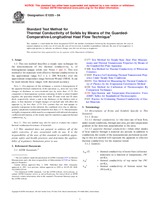
ASTM E1225-04
Standard Test Method for Thermal Conductivity of Solids by Means of the Guarded-Comparative-Longitudinal Heat Flow Technique
Automatische name übersetzung:
Standard Test Method for Wärmeleitfähigkeit von Feststoffen mit Hilfe der Bewachter - Vergleichs - Longitudinal Wärmefluss -Technik
NORM herausgegeben am 1.5.2004
Informationen über die Norm:
Bezeichnung normen: ASTM E1225-04
Anmerkung: UNGÜLTIG
Ausgabedatum normen: 1.5.2004
SKU: NS-40924
Zahl der Seiten: 8
Gewicht ca.: 24 g (0.05 Pfund)
Land: Amerikanische technische Norm
Kategorie: Technische Normen ASTM
Ergänzende Informationen
| Significance and Use | ||
|
The comparative method of measurement of thermal conductivity is especially useful for engineering materials including ceramics, polymers, metals and alloys, refractories, carbons, and graphites including combinations and other composite forms of each. Proper design of a guarded-longitudinal system is difficult and it is not practical in a method of this type to try to establish details of construction and procedures to cover all contingencies that might offer difficulties to a person without technical knowledge concerning theory of heat flow, temperature measurements, and general testing practices. Standardization of this test method is not intended to restrict in any way the future development by research workers of new or methods or improved procedures. However, new or improved techniques must be thoroughly tested. Requirements for qualifying an apparatus are outlined in Section 10. |
||
| 1. Scope | ||
|
1.1 This test method describes a steady state technique for the determination of the thermal conductivity, , of homogeneous-opaque solids (see Note 1 and Note 2). This test method is for materials with effective thermal conductivities in the approximate range 0.2 200 W/(mK) over the approximate temperature range between 90 and 1300 K. It can be used outside these ranges with decreased accuracy. Note 0For purposes of this technique, a system is homogeneous if the apparent thermal conductivity of the specimen, A, does not vary with changes of thickness or cross-sectional area by more than 5 %. For composites or heterogeneous systems consisting of slabs or plates bonded together, the specimen should be more than 20 units wide and 20 units thick, respectively, where a unit is the thickness of the thickest slab or plate, so that diameter or length changes of one-half unit will affect the apparent A by less than 5 %. For systems that are non-opaque or partially transparent in the infrared, the combined error due to inhomogeneity and photon transmission should be less than 5 %. Measurements on highly transparent solids must be accompanied with infrared absorption coefficient information, or the results must be reported as apparent thermal conductivity, A. Note 2This test method may also be used to evaluate the contact thermal conductance/resistance of materials. 1.2 This standard does not purport to address all of the safety concerns, if any, associated with its use. It is the responsibility of the user of this standard to establish appropriate safety and health practices and determine the applicability of regulatory limitations prior to use. |
||
| 2. Referenced Documents | ||
|
Empfehlungen:

Aktualisierung der technischen Normen
Wollen Sie sich sicher sein, dass Sie nur die gültigen technischen Normen verwenden?
Wir bieten Ihnen eine Lösung, die Ihnen eine Monatsübersicht über die Aktualität der von Ihnen angewandten Normen sicher stellt.
Brauchen Sie mehr Informationen? Sehen Sie sich diese Seite an.