 Cookies
Wir benötigen Ihre Einwilligung zur Verwendung der einzelnen Daten, damit Sie unter anderem Informationen zu Ihren Interessen einsehen können. Klicken Sie auf "OK", um Ihre Zustimmung zu erteilen.
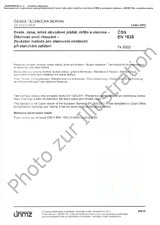
ČSN EN 14620-5 (698218)
Design and manufacture of site built, vertical, cylindrical, flat-bottomed tank systems for the storage of refrigerated, liquefied gases with operating temperatures between 0 °C and -196 °C - Part 5: Testing, drying, purging and cool- down
Name übersetzen
NORM herausgegeben am 1.3.2026
Informationen über die Norm:
Bezeichnung normen: ČSN EN 14620-5
Zeichen: 698218
Katalog-Nummer: 522848
Ausgabedatum normen: 1.3.2026
SKU: NS-1262055
Zahl der Seiten: 32
Gewicht ca.: 96 g (0.21 Pfund)
Land: Tschechische technische Norm
Kategorie: Technische Normen ČSN
Kategorie - ähnliche Normen:
Die Annotation des Normtextes ČSN EN 14620-5 (698218):
This document is applicable to the design and manufacture of site built, vertical, cylindrical, flat-bottomed tank systems for the storage of refrigerated, liquefied gases with operating temperatures between 0 °C and -196°C. It specifies the requirements for testing, drying, purging, cool-down and decommissioning of refrigerated liquefied gas storage tank systems.
The tank systems covered by this document are used to store large volumes of hydrocarbon products, ammonia and other non-hydrocarbon gases with low temperature boiling points, generally called "Refrigerated Liquefied Gases" (RLGs). Typical products stored in the tank systems are: methane, ethane, propane, butane, ethylene, propylene, butadiene (this range includes Liquefied Natural Gas (LNG) and Liquefied Petroleum Gas (LPG), ammonia, nitrogen, oxygen and argon.
NOTE - Properties of the gases are given in Annex A EN 14620-1:2024.
This document provides requirements and specifies measures to be taken following completion of major tank construction activities and before the tank is brought in to service. It provides requirements for full-height and partial height hydrostatic testing to check the structural integrity of tanks and the capacity of the foundations. Settlement monitoring of the foundations at this stage form the starting point of an annual settlement monitoring programme for the tank foundation. Recommendations are given for marker systems for such monitoring. Requirements for water quality of both fresh water and seawater used during hydrotest, are provided to avoid the risk of corrosion of tanks and appurtenances.
Guidance and requirements for positive and negative pneumatic tests to further check tank structural integrity, leak tightness of welds and the function of pressure and vacuum relief valve systems are also given. Requirements specific to testing of double-wall and membrane type tanks is included.
Rules and procedures for commissioning activities, including drying and purging with inert and product gas are provided, including required oxygen concentrations for various RLG´s. The document also provides guidance for cool-down procedures and suggestions for temperature monitoring, including an informative Annex A.
For major maintenance inspection or at the end of the life of the tank, decommissioning will be required. Guidance on safe decommissioning processes is provided.
Suggested procedures for Global testing for membrane tanks are provided in informative Annex B
This document is applicable to the design and manufacture of site built, vertical, cylindrical, flat-bottomed tank systems for the storage of refrigerated, liquefied gases with operating temperatures between 0 °C and -196°C
Normansicht ČSN EN 14620-5 (698218)
Empfehlungen:

Aktualisierung der technischen Normen
Wollen Sie sich sicher sein, dass Sie nur die gültigen technischen Normen verwenden?
Wir bieten Ihnen eine Lösung, die Ihnen eine Monatsübersicht über die Aktualität der von Ihnen angewandten Normen sicher stellt.
Brauchen Sie mehr Informationen? Sehen Sie sich diese Seite an.